By Bernice Elizabeth Green
There are so many things we can learn from The Rev. Dr. Martin Luther King, Jr. His trusted associate, the late Congressman and Civil Rights leader John Lewis, shared a great story. Dr. King was meeting with U.S. President Lyndon Baines Johnson in Washington, DC, and did not feel the meeting was going well. antidote for that meeting was prayer, prayer. He was saying that he felt that the meeting was not going well.
The meeting was about the Voting Rights Act. President Johnson was stressing the point that the time was not right for voting rights.
John was saying basically that he felt that it was not a good meeting. Martin said to Abernathy, “The antidote is prayer.” The Rev. Ralph David Abernathy, King’s right hand, was scheduled to pray, but, according to John, Martin took over, “I’ll pray.” And he did in the meeting with President Johnson.
Apparently, Johnson had been following Martin’s speeches and prayers.
And John said he’d been following Martin’s speeches and prayers. But Martin said, “But this prayer is a prayer you will always remember.” I am paraphrasing, here. So, John said he was sitting around basically saying to himself, “I’ll be glad when this is over!”
But then “Martin prayed!
When he finished, John told me, a third of those people in the room had tears in their eyes. Then they, they just jumped right up and said, “Goodbyes”. “I wish, you know, you could be considered.”
And Martin walked out, in a hurry, almost demonstrating anger, according to John. When Martin got to the security gate, the guard stopped him and said, “Look, the President would like you to come back, you and your officers.
Martin said, “Well, no. “I got to bring four back with me.” Martin wanted to bring young John Lewis back in with him. After Security okayed all four, they went back in.
And that’s when Johnson, asked them, “How are we gonna do this?”
John told me, that there was a whole change in that room when they returned to it. And when that meeting was over, he said hg. So, he felt that prayer really made the difference. So, Martin feeling that, uh, and he res- he, um, he was
John told me, that there was a whole change in that room when they returned to it.
And then he said, “Martin said a prayer and I heard Martin pray.”
“But that day,” he said, “when Martin finished praying, I could not believe it. I was trembling. I really was.”
“You know, I was with him all the time following him around. I was a young guy,” John Lewis told me. “Martin felt the prayer touched Johnson to bring about this change in terms of the Voting Rights Bill.”
“Man,” John said, “That prayer! I wish I could’ve recorded it. I wish I had taped it.”
(Note to readers: Last Sunday (18), Ed Towns delivered a sermon in tribute to The Rev. Dr. Martin Luther King Jr. at the historic Berean Baptist Church on Bergen Street in Crown Heights. How prayer works was one of the subjects covered.
Today is the federal holiday that honors civil rights icon Dr. Martin Luther King Jr. He was born January 15, 1929, and was assassinated April 4, 1968,
…. (Thank You) we can stand up amid the problems and difficulties and trials of life and not give in. We thank you for our foreparents, who’ve given us something in the midst of the darkness of exploitation and oppression to keep going. Grant that we will go on with the proper faith and the proper determination of will, so that we will be able to make a creative contribution to this world. — a prayer by Rev. Dr. Martin Luther King, Jr. from “The Guidepost”
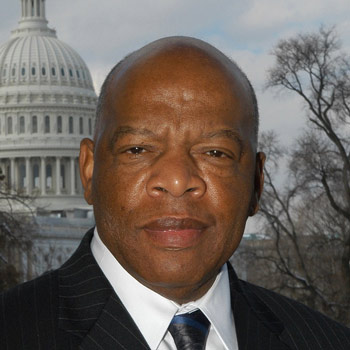
John Robert Lewis (February 21, 1940 – July 17, 2020) was an American civil rights activist and statesman who served in the United States House of Representatives for Georgia’s 5th congressional district from 1987 until his death in 2020. He participated in the 1960 Nashville sit-ins and the Freedom Rides, was the chairman of the Student Nonviolent Coordinating Committee (SNCC) from 1963 to 1966, and was one of the “Big Six” leaders of groups who organized the 1963 March on Washington.
Fulfilling many key roles in the civil rights movement and its actions to end legalized racial segregation in the United States, in 1965 Lewis led the first of three Selma to Montgomery marches across the Edmund Pettus Bridge where, in an incident that became known as Bloody Sunday, state troopers and police attacked Lewis and the other marchers.